
Table of Contents
As an Amazon Associate, we earn from qualifying purchases. This means we may receive a small commission at no extra cost to you when you buy through links on this page.
Introduction: The Importance of the Right Car Seat
Ensuring your child’s safety whilst travelling in a vehicle is paramount. In the UK, it’s a legal requirement for all children to travel in a car seat until they are 12 years old or 135cm (4ft 5in) tall, whichever comes first. However, choosing the right car seat is just as crucial as using one at all. The correct car seat must be appropriate for your child’s age, weight, and height. This guide will navigate you through the different stages of car seats available in 2026, focusing on both the older R44/04 standard and the newer, safer i-Size (R129) regulations.
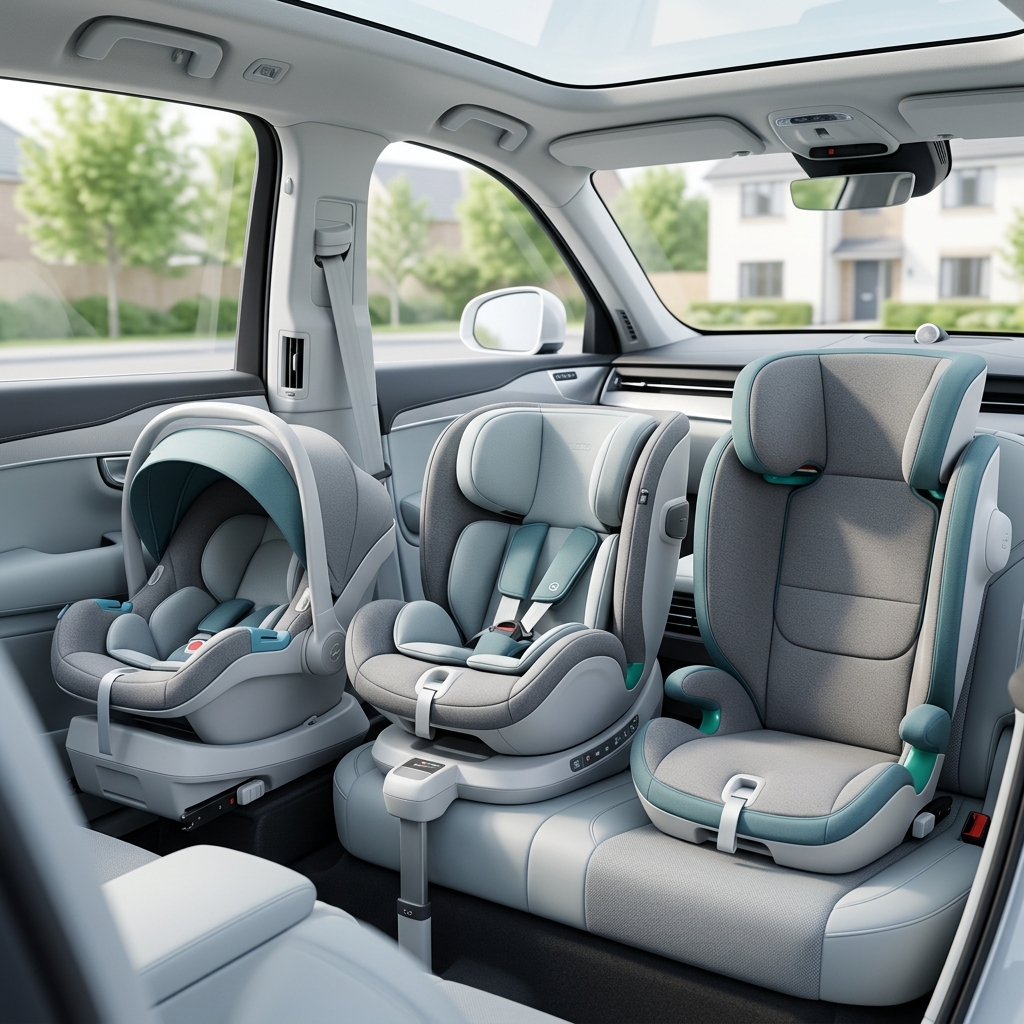
Understanding Car Seat Regulations: R44/04 vs. i-Size (R129)
For years, the R44/04 standard was the primary regulation for car seats in Europe. This standard groups seats by weight. However, it’s increasingly recognised that children of the same weight can have drastically different heights and body development. This led to the development of i-Size (R129), a more modern regulation focusing on a child’s height.
R44/04
- Groups seats by child’s weight.
- Allows forward-facing travel at a lower age/weight than i-Size.
- Side impact protection standards were less stringent.
i-Size (R129)
- Groups seats by child’s height.
- Requires rearward-facing travel until at least 15 months.
- Offers improved side impact protection testing.
- Often utilises ISOFIX for a more secure installation.
The transition to i-Size is well underway. While R44/04 seats are still currently available for purchase, manufacturers are phasing them out. By late 2027, it’s expected that R44/04 seats will no longer be legally sold new in the UK, though existing seats can continue to be used if they meet safety standards and haven’t been involved in an accident.
Stage 0: Birth to 15 Months (Approx.) – Rear-Facing Baby Car Seats
This stage focuses on Group 0 and 0+ car seats, designed for newborns and infants. The primary focus is on rear-facing travel. Numerous studies show that rear-facing is significantly safer for young infants, protecting their vulnerable necks and spines in the event of a collision.
Key Features to Look For:
- Lie-flat options: Some seats allow for a more reclined position, ideal for longer journeys and preventing slumping.
- Newborn inserts: Provide extra support and cushioning for very young babies.
- Side Impact Protection: Crucial for absorbing energy in a side collision.
- ISOFIX compatibility: Offers a more secure installation compared to seatbelt fitting.
Average Weight/Height Limits:
- Group 0: Birth to 10kg (approx. 22lbs)
- Group 0+: Birth to 13kg (approx. 28lbs)
Popular Models (2026):
| Model | Approx. Price (GBP) | Regulation | Key Features |
|---|---|---|---|
| Recaro Primo Europe Plus | £199 | R44/04 | Excellent side impact protection, comfortable newborn insert. |
| Maxi-Cosi Pearl 360 | £289 | i-Size | 360° rotation, easy to adjust. |
| Nuna Rebl Next i-Size | £450 | i-Size | Recline function, smart level technology. |
Stage 1: 9 Months to 4 Years (Approx.) – Extended Rear-Facing & First Stage Forward-Facing
Stage 1 sees a transition. Many parents now opt for extended rear-facing (ERF), keeping their child rear-facing for longer, often until 4 years old. ERF is consistently proven to be the safest position for a child. However, forward-facing seats with a robust 5-point harness are also available.
Considerations:
- Extended Rear-Facing: Offers superior protection, particularly in frontal collisions.
- ISOFIX Bases: Essential for secure installation, especially with rotating seats.
- 5-Point Harness: Ensures the child is securely restrained in the seat.
Weight and Height Limits:
- Typically up to 18kg (approx. 40lbs) and 105cm.
Stage 2: 4 Years to 7 Years (Approx.) – High-Back Booster Seats
As your child grows, a high-back booster seat is the next step. These seats position the vehicle’s seatbelt correctly over your child’s body. A high back provides additional head and side impact protection, unlike booster cushions.
Important Considerations:
- Proper Fit: Ensure the vehicle’s seatbelt fits snugly across your child’s shoulder and lap, not the neck or stomach.
- Side Impact Protection: Look for seats with enhanced side impact protection features.
- Adjustable Headrest: Allows the seat to grow with your child.
Weight and Height Limits:
- Typically 15kg to 25kg (approx. 33lbs to 55lbs) and 100cm to 135cm.
Stage 3: 7 Years to 12 Years (Approx.) – Booster Cushions & High-Back Boosters
This final stage involves either a booster cushion or a high-back booster. A booster cushion simply elevates your child, allowing the seatbelt to fit correctly. However, a high-back booster offers significantly more protection. A child is generally ready to sit without a booster when they are 135cm tall.
Booster Cushion vs. High-Back Booster:
Booster cushions are the least protective option, offering no side impact protection. High-back boosters provide vital head and side impact protection, making them the safer choice.
Legal Requirements:
A child must use a car seat or booster until they are 12 years old or 135cm tall.
Weight and Height Limits:
- Typically 22kg to 36kg (approx. 48lbs to 79lbs) and 125cm to 150cm.
ISOFIX: A Secure Connection
ISOFIX is an international standard for car seat fittings. It provides a direct connection between the car seat and the vehicle chassis, offering a more secure and stable installation than seatbelt-only fitting.
Benefits of ISOFIX:
- Reduced installation errors.
- Increased stability.
- Often used with rotating car seats for easier access.
Checking Compatibility:
Most cars manufactured after 2006 are ISOFIX compatible. Look for ISOFIX anchor points in your vehicle’s seats, usually marked with ISOFIX logos. Your vehicle’s handbook will confirm compatibility.
Car Seat Safety Checks & Installation
Even with ISOFIX, incorrect installation is common. It’s highly recommended to have your car seat professionally checked by a qualified fitter.
Resources for Qualified Fitters:
- RoSPA (Royal Society for the Prevention of Accidents): https://www.rospa.com/road-safety/advice/child-car-seats/
- Local councils often offer car seat checking services.
Common Mistakes:
- Not tightening the harness sufficiently.
- Incorrectly routing the seatbelt.
- Using incompatible ISOFIX bases.
Second-Hand Car Seats: Risks and Considerations
Using a second-hand car seat is strongly discouraged. You cannot be certain of its history. It may have been involved in an accident, even a minor one, which can compromise its structural integrity. The plastics can degrade over time. Don’t risk your child’s safety.
Car Seat Age Guide UK 2026: Frequently Asked Questions
Q: When can my child move from rear-facing to forward-facing?
Ideally, keep your child rear-facing for as long as possible, even beyond 15 months. i-Size regulations require rear-facing until at least 15 months, but extended rear-facing until 4 years is recommended for optimal safety.
Q: Can I use a second-hand car seat?
No. It is not recommended to use a second-hand car seat unless you know its full history and can confirm it hasn’t been involved in an accident.
Q: What is the difference between a booster cushion and a high-back booster?
A booster cushion simply elevates your child, while a high-back booster provides additional head and side impact protection. High-back boosters are significantly safer.
Q: My child is 130cm tall and 7 years old. Can they stop using a car seat?
No. They must continue to use a car seat or booster until they are either 12 years old or 135cm tall, whichever comes first.
Q: What does ‘i-Size’ mean?
i-Size (R129) is a more recent car seat safety regulation that focuses on a child’s height rather than weight. It prioritizes rear-facing travel for longer and includes more rigorous side-impact testing.