
Table of Contents
As an Amazon Associate, we earn from qualifying purchases. This means we may receive a small commission at no extra cost to you when you buy through links on this page.
What is a Baby Activity Centre & Why Do You Need One?
Baby activity centres are designed to provide a stimulating and safe environment for your little one to explore, learn, and develop crucial skills. They typically feature a variety of interactive toys, sounds, and textures that encourage motor skill development (reaching, grasping, kicking), cognitive skills (cause and effect, problem-solving), and sensory exploration. Unlike walkers, many activity centres are stationary, encouraging core strength development as babies learn to sit and support themselves.
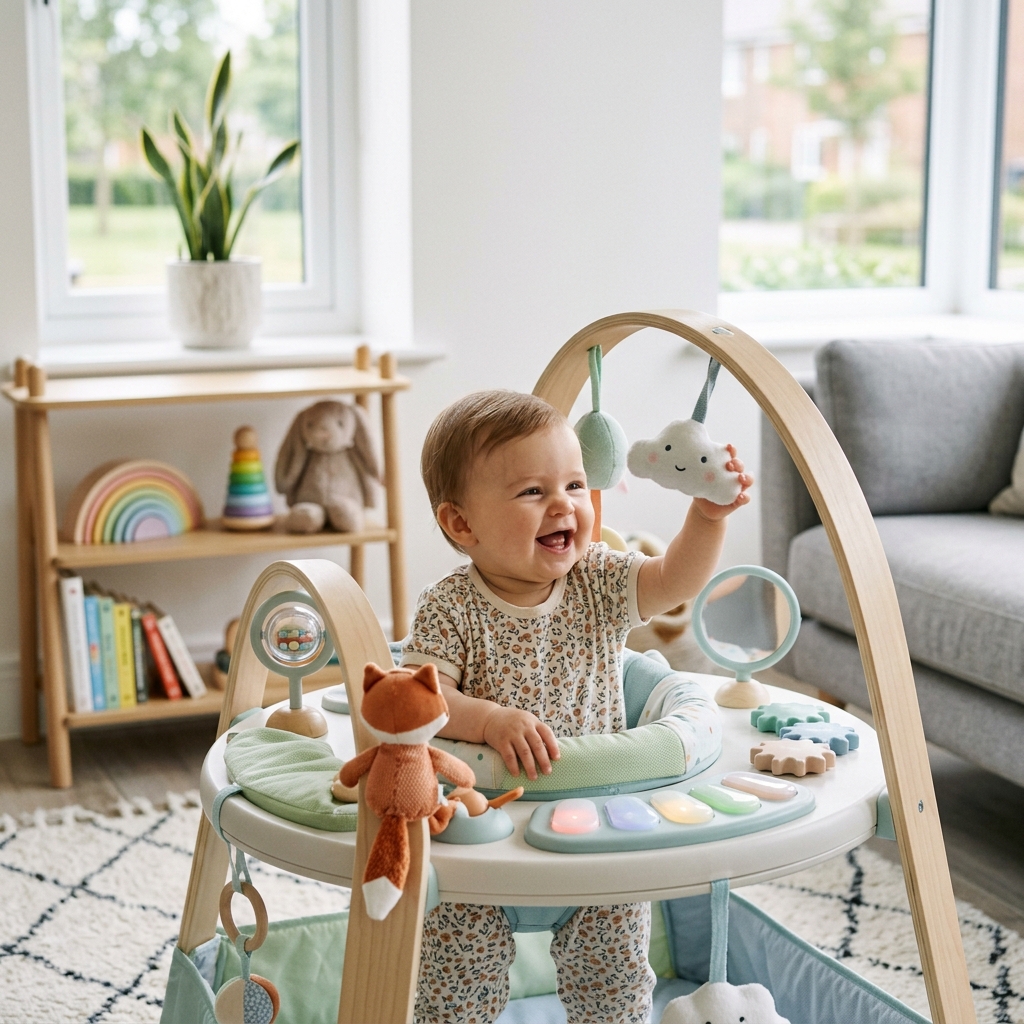
For parents, activity centres can be a lifesaver! They provide a safe space for baby to be entertained, allowing you to get on with tasks around the house or simply enjoy a moment of peace. It’s important to differentiate between activity centres, walkers, and play gyms. Play gyms are typically mat-based with overhead toys, ideal for newborns. Walkers allow babies to move around independently (more on that later!). Activity centres offer a more contained and feature-rich experience.
Types of Baby Activity Centres Available in the UK
Stationary Activity Centres
These centres provide a fixed, interactive play space. They’re excellent for developing core strength and encourage babies to stay put while exploring the multitude of toys.
- Pros: Promote core strength, safe stationary play, a wide range of toys.
- Cons: Baby doesn’t get to move around independently.
Walkers (with/without activity panels)
Walkers allow babies to move around independently, but their use is often debated (see section “Walkers vs. Activity Centres”). Those with activity panels combine mobility with interactive play.
- Pros: Encourage mobility (potentially), offer interactive play.
- Cons: Can delay developmental milestones, potential safety hazards.
3-in-1 Activity Centres
These versatile centres typically transition from a stationary activity centre to a walker (with support) and then to a push-along toy as your baby grows.
- Pros: Longevity, multiple stages of development supported.
- Cons: Can be bulky, walker function may have the same concerns as dedicated walkers.
Play Gyms/Activity Mats
Ideal for newborns and younger babies, these mats feature overhead toys to encourage reaching and kicking.
- Pros: Suitable for newborns, promotes early development, often portable.
- Cons: Limited longevity, fewer interactive features than other centres.
Portable Travel Activity Centres
Designed for on-the-go entertainment, these centres often fold up compactly for easy transport.
- Pros: Convenient for travel, compact storage.
- Cons: May have fewer features than larger centres.
Key Features to Consider When Buying (2026 Trends)
When choosing an activity centre in 2026, consider these features:
- Safety Standards (EN 71): Ensure the centre meets the latest European safety standards.
- Adjustability: Height settings are crucial for adapting to your baby’s growth.
- Interactive Toys/Sounds: Look for a variety of engaging toys that stimulate different senses. Expect more sophisticated sounds and lights in 2026 models.
- Ease of Cleaning: Accidents happen! Removable, washable fabrics are a must.
- Portability & Foldability: Important if you have limited space or want to take the centre to grandparents’ house.
- Weight Capacity: Check the maximum weight limit to ensure it’s suitable for your baby.
- Integrated App Connectivity: A growing trend in 2026 is activity centres that connect to apps, allowing parents to track playtime and developmental progress (though not essential).
Top 5 Baby Activity Centres UK – Our 2026 Reviews
Our Top Pick: Skip Hop Explore & More Jumpscape Foldaway Jumper
The Skip Hop Jumpscape combines interactive play with a space-saving design. Its foldaway feature is a game-changer for smaller homes. The 360-degree rotating seat and variety of toys provide excellent engagement.
Here’s a comparison of our top picks:
| Product | Price (GBP) | Age Range | Key Features | Pros | Cons |
|---|---|---|---|---|---|
| VTech Sit-to-Stand Learning Walker | £65.00 | 9-36 months | Interactive buttons, sounds, shapes, phrases. Converts to walker. | Affordable, versatile, encourages early learning. | Can be overwhelming with sounds, walker function may not be ideal for all. |
| Fisher-Price 3-in-1 Activity Centre | £99.99 | 6+ months | Rotating seat, multiple activity stations, adjustable height. | Durable, lots of activities, grows with baby. | Bulky, can take up a lot of space. |
| Skip Hop Explore & More Jumpscape Foldaway Jumper | £130.00 | 6+ months | 360° rotating seat, light-up buttons, interactive toys, foldaway design. | Space-saving, engaging, good quality. | More expensive than some options. |
| Baby Einstein Neptune Ocean Motion Station | £80.00 | 6+ months | Ocean-themed, rotating seat, interactive toys, calming music. | Calming and engaging, visually appealing. | Fewer interactive features compared to some others. |
| Joovy Spoonful Activity Centre | £115.00 | 6+ months | Modern design, adjustable height, multiple activity stations, removable toy trays. | Stylish, easy to clean, good value for money. | Might not appeal to all babies with its minimalist aesthetic. |
Walkers vs. Activity Centres: Which is Right for Your Baby?
The debate around baby walkers continues. While they offer the opportunity for independent movement, concerns remain about their impact on development. Walkers can delay the development of core strength and balance, as babies don’t go through the natural stages of learning to sit, crawl, and pull themselves up. They can also pose safety risks, such as falls down stairs.
Stationary activity centres are generally considered a safer and more developmentally beneficial option. They encourage babies to develop core strength and stability while exploring a variety of toys. If you’re considering a 3-in-1 centre with a walker function, use it sparingly and only under strict supervision.
Safety Tips for Using Baby Activity Centres
- Supervision: Never leave your baby unattended in an activity centre.
- Floor Surface: Place the centre on a flat, stable surface.
- Avoiding Stairs: Always keep the centre away from stairs or other hazards.
- Weight Limits: Ensure your baby’s weight is within the centre’s specified limit.
- Toy Hygiene: Regularly clean and disinfect the toys.
- Check for Recalls: Stay informed about product recalls – check the RoSPA website: https://www.rospa.com/ (This is a placeholder link)
How Long Can Babies Use Activity Centres?
Activity centres are best suited for babies who can sit independently (usually around 6 months). Use should be limited to short periods (15-30 minutes at a time) to prevent overstimulation and encourage a variety of play experiences. Once your baby starts to crawl or pull themselves up, they may lose interest in the activity centre and be ready for more explorative play.
Where to Buy Baby Activity Centres in the UK (2026)
- Amazon UK
- John Lewis
- Argos
- Smyths Toys
- Boots
- Independent baby stores (search online for local options)
Frequently Asked Questions (FAQs)
Q: How do I clean a baby activity centre?
Most activity centres have removable fabric parts that can be machine washed. Wipe down the plastic components with a damp cloth and mild detergent. Ensure everything is completely dry before reassembling.
Q: How do I store an activity centre when not in use?
Foldable activity centres are easiest to store. If your centre doesn’t fold, disassemble it as much as possible and store the components in a large bag or box. Space-saving models are increasingly popular.
Q: My baby doesn’t seem interested in the activity centre. What should I do?
Rotate the toys regularly to keep things fresh and engaging. Ensure the centre is adjusted to the correct height. Some babies simply prefer different types of play, so don’t force it.
Q: Are activity centres suitable for all babies?
Not necessarily. Babies develop at different rates. It’s important to ensure your baby has the core strength to sit upright before using an activity centre. Always consult your health visitor if you have concerns.
Q: What should I look for in terms of the longevity of an activity centre?
Consider centres with adjustable height settings and multiple stages of play (like 3-in-1 options). Look for durable materials and a design that can adapt to your baby’s changing needs over several months.